

You can support a child who is afraid of making mistakes by modeling how to handle errors with patience and curiosity rather than frustration. When parents show that being wrong is just a step in learning, it helps a child who is afraid of making mistakes feel safer taking risks. This shift in perspective transforms a perceived failure into a useful piece of information for the future.
Avoid mistakes that hinder helping your child

Many adults mistakenly try to protect children from all feelings of failure, but this often makes the child more sensitive to minor errors. This approach creates a fragile sense of confidence that breaks the moment something goes wrong.
The most common mistake is “over-functioning,” where you solve a child’s problem before they have a chance to attempt it. This signals that you don’t trust their capability. If the child is under age seven, provide a hint to guide their thinking.
| What most people do | What to do instead | Why it matters |
|---|---|---|
| Praising the result | Praising the effort | Encourages growth mindset |
| Removing all obstacles | Scaffolding the challenge | Builds problem-solving skills |
| Hiding your own mistakes | Narrating your recovery | Normalizes human imperfection |
| Correcting them quickly | Asking open questions | Promotes critical thinking |
| Avoiding tough tasks | Gradual exposure training | Increases tolerance for stress |
| Focusing on the grade | Focusing on the process | Lowers performance anxiety |
Watch for the “rescue reflex.” If you feel a sudden urge to fix their work, stop. That urge is your anxiety, not theirs. If you intervene, you steal their opportunity to build resilience.
Change your reaction to small errors
When a child makes a mistake, your immediate reaction dictates whether they view it as a disaster or a lesson. If you react with a sigh or a quick correction, they learn that errors are shameful and should be hidden. If you react with interest, they learn that mistakes are data points.
Instead of saying “No, that’s wrong,” try saying “That’s an interesting way to do it, tell me your thinking.” This keeps the child engaged in the task rather than shutting down. If they’re younger than 7, keep your tone light and focused on the physical process of fixing things. If they’re older, ask them to identify one thing they would do differently next time. This puts the power back in their hands.
A common mistake is rushing to “fix” the problem for them. This saves time in the moment but it costs the child their chance to build resilience. If you see them struggling, resist the urge to take over. If the task is too hard, break it into smaller parts. If the task is age-appropriate, simply wait 30 seconds before offering a hint. The goal is to provide just enough support so they can succeed on their own terms. This requires you to observe their frustration level; if they’re crying, pause the activity, but if they’re just grumbling, let them continue.
Focus on the process not the outcome

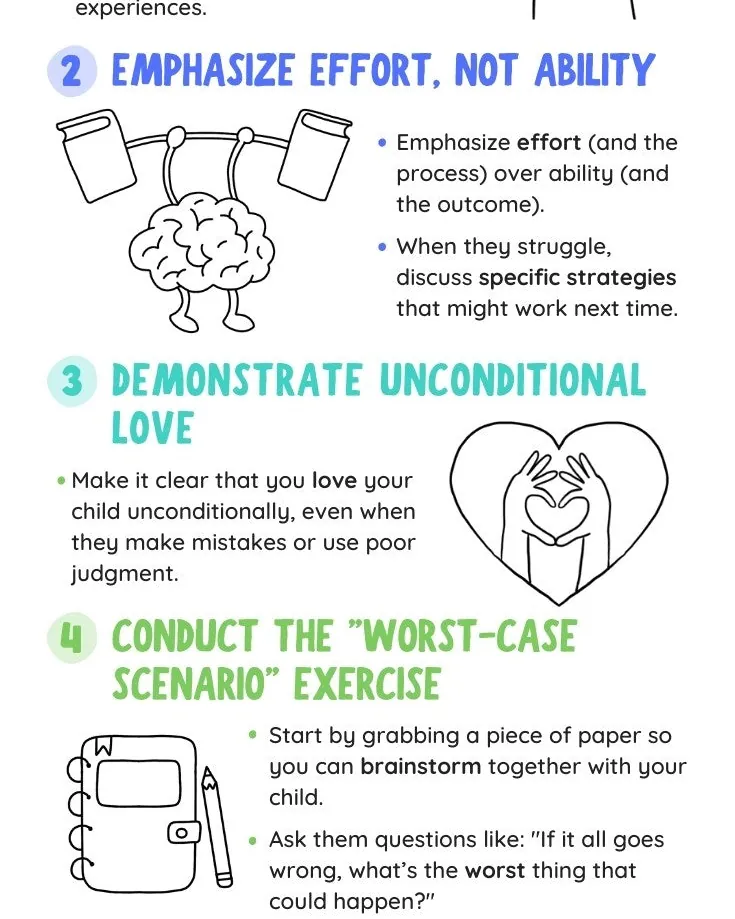
Shifting your focus away from the final result helps lower the pressure a child feels during a task. When you talk about the steps taken, you show that the journey is more valuable than a perfect score.
The American Academy of Pediatrics notes that building resilience involves allowing children to solve problems at their own pace. This means you should highlight the “how” instead of the “what.” Did they try a new strategy? Did they stay calm when the first attempt failed? These are the behaviors that deserve your attention.
When a child is afraid, they often avoid tasks they can’t do perfectly. If you see them avoiding a challenge, don’t force them into it. Instead, offer a “low-stakes” version of the task. If they’re afraid to draw because they can’t make it look realistic, suggest a session of abstract scribbling where there’s no “right” way to hold the crayon. This builds the habit of putting pen to paper without the fear of judgment. Over time, the anxiety will decrease as they realize that the world doesn’t end when a mark goes in the wrong place. This isn’t for children currently dealing with severe clinical anxiety; if your child has panic attacks or refuses to participate in daily life, talk to a pediatrician.
Strategies to stop the fear of failure
You can help your child manage their internal monologue by giving them specific scripts to use when they feel stuck. These phrases replace the “I am bad at this” narrative with a “I am still learning” mindset.
- Label the feeling: Encourage them to say “I feel frustrated because this is hard” instead of “I am a failure.”
- The “Yet” method: Teach them to add the word “yet” to the end of any negative sentence about their skills.
- Model your own blunders: Narrate your own mistakes out loud, such as “Oh, I put the salt in the coffee! I will just make a fresh pot.”
- Focus on the experiment: Treat every activity as a test to see what happens, rather than a test of their intelligence.
- Set a time limit: If they’re stuck on a mistake for more than 10 minutes, suggest a break to do something else before returning to the task.
Steps for guiding a child through mistakes
- Stop the immediate correction. When you see an error, pause for 5 seconds. This gives the child the space to catch it themselves. If they don’t notice, ask a question like, “Does that look like what you expected?”
- Validate the emotion. It’s okay to be annoyed when things go wrong. Say, “I know it’s frustrating when the tower falls down.” This shows you understand their feelings without agreeing that the mistake is a catastrophe.
- Review the effort. Ask what they did that worked well. Even if the final result is messy, find one step that showed good focus or creativity. This reinforces that their effort has value regardless of the outcome.
- Discuss the next attempt. Ask, “What could we try differently next time?” This moves the focus from the past mistake to the future possibility. Keep the suggestion simple, like “Maybe we use more tape” or “Maybe we move slower.”
- Model self-compassion. If you make a mistake, don’t apologize profusely or get angry. Say, “I messed that up, but I am going to try again.” This shows them that being wrong is a normal part of life.
- Celebrate the recovery. When they fix a mistake or try again after failing, acknowledge it. “I saw how you kept going even when it was hard, that was very brave.” This builds the habit of persistence.
Frequently asked questions
How long does it take for a child to stop fearing mistakes?
It typically takes 3 to 6 months of consistent modeling to see a shift in a child’s confidence. This assumes you’re using the same positive language daily. If the child has a high baseline of anxiety, it may take longer. You’ll know it’s working when you hear them use the “yet” language or see them start a task they previously avoided without waiting for your permission.
Is it safe to let my child struggle with a mistake?
It’s safe to let a child struggle as long as the task doesn’t involve physical danger. The frustration they feel is a normal part of managing complex emotions. If they’re crying or physically lashing out, it’s time to step in and offer a break. If they’re just quiet or grumbling, they’re likely in the “productive struggle” zone where real learning happens.
What happens if I ignore their mistakes?
Ignoring mistakes can lead a child to believe that you don’t care about their progress or that they’re doing something wrong that you’re too polite to mention. It’s better to acknowledge the mistake neutrally and focus on the solution.
Does it matter if I am a perfectionist?
It matters because children often mirror the way their parents treat their own errors. If you’re a perfectionist, your child will likely notice how you react when you burn dinner or misplace your keys. You don’t have to be perfect to help them; you just need to show them how you handle your own mistakes. Being honest about your own struggles is one of the most powerful tools you have.
Why does my child get angry when they make a mistake?
The anger usually comes from a feeling of losing control or a fear that they aren’t meeting expectations. They may have set a goal for themselves that’s slightly out of reach, and the mistake feels like a personal failure. By validating the anger and helping them focus on the process, you help them move from a state of emotional reaction to a state of problem-solving.
How can I tell if the fear is too much?
The fear is too much if it prevents the child from participating in school, sports, or social activities. If you notice they’re having panic attacks, refusing to speak, or avoiding tasks that they’re clearly capable of doing, consult a pediatrician. A professional can help you determine if the fear is a normal developmental stage or if it requires additional support from a child therapist.
Conclusion
Building a sense of security around mistakes is a slow process that requires patience. When you focus on the process and model a healthy attitude toward your own errors, you give your child the tools to handle challenges with confidence. Keep the environment low-pressure and remember that your reaction to their mistakes is more important than the mistakes themselves.